
Published 12 July 2026
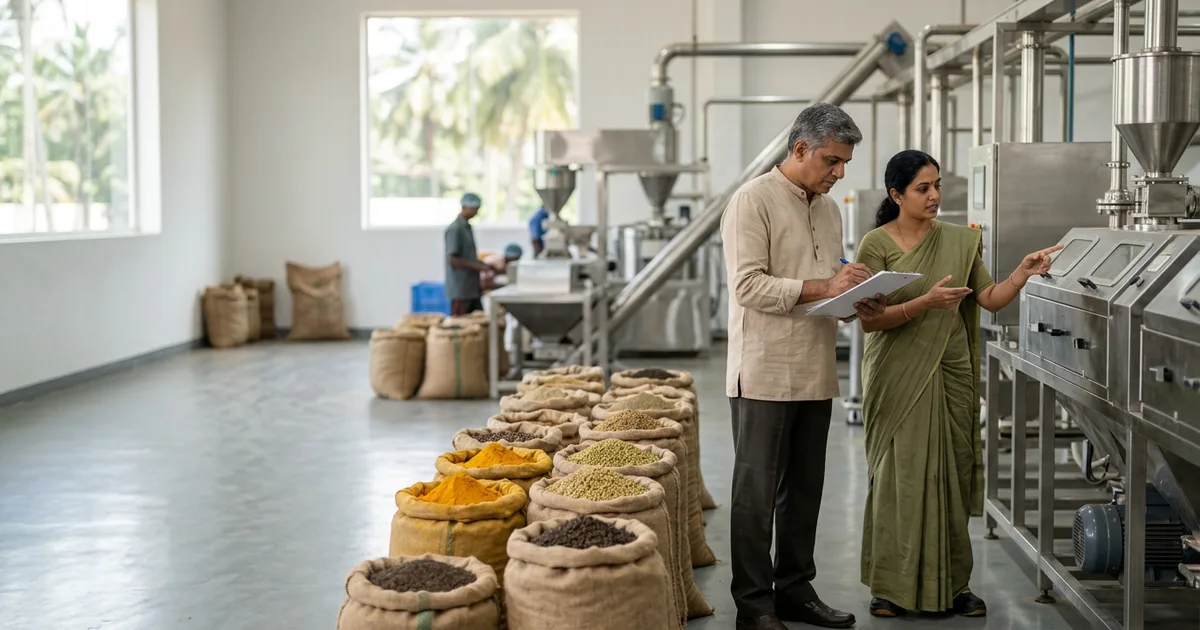
ISO 14001 is the international standard for Environmental Management Systems (EMS) — it certifies that a business has a structured system for managing its environmental impact, not that its product itself is "eco-friendly." For Kerala's exporters of spices, coir, rubber, and seafood, it is not a legal requirement, but it is fast becoming a practical one: international buyers increasingly use it as a proxy for a clean, well-run supply chain, and one Kerala-specific EU regulation now makes environmental documentation unavoidable for the state's rubber sector.
What does ISO 14001 actually certify?
ISO 14001 certifies that a company has a documented system to identify its environmental risks, meet applicable environmental laws, and continuously improve — covering things like waste handling, effluent discharge, energy use, and pollution prevention. Certification is voluntary and issued by independent, accredited certification bodies (in India, these are accredited by the National Accreditation Board for Certification Bodies, NABCB, under the Quality Council of India), not by ISO itself or by any government department. A useful real-world example: the Spices Board of India's own Quality Evaluation Laboratory in Kochi has held ISO 14001 certification since 1999, alongside ISO 9001 — showing the standard has long-standing credibility within Kerala's own export institutions.
Why do EU and US buyers increasingly ask for it?
ISO 14001 requires certified companies to extend environmental oversight to their own suppliers, which is why buyers treat it as a shortcut signal for "this supply chain is being managed responsibly." That said, it's important to be precise about where it's actually required versus expected. For spices specifically, EU buyer-requirement guidance (from CBI, the EU's own trade-promotion body) does not name ISO 14001 as a market-entry requirement — spice buyers are more focused on pesticide residue limits and named sustainability schemes like Rainforest Alliance or UEBT's Herbs & Spices Programme. ISO 14001 functions as a complementary credential that supports buyer trust rather than a checkbox EU customs demands.
Where a real regulatory push exists: rubber and the EU Deforestation Regulation
The one area where Kerala exporters face a genuine, dated EU rule is natural rubber. The EU Deforestation Regulation (EUDR) names rubber as one of its covered commodities — alongside cattle, cocoa, coffee, palm oil, soy, and wood — and requires proof that EU-bound goods are deforestation-free, with an application date of 30 December 2026 per the European Commission's own implementation page (exact phased timelines for micro/small operators have shifted more than once, so treat only the headline date as firm). Kerala accounts for the large majority of India's natural rubber production, which makes traceability and environmental documentation directly relevant to the state's rubber processors and exporters — an ISO 14001 system is a natural fit for building the internal records this kind of due diligence requires.
Sector-by-sector reality check
- Spices: compliance floor is Spices Board registration (CRES) plus pesticide/MRL testing; ISO 14001 is a voluntary add-on that supports buyer confidence, not a named EU requirement.
- Coir: base legal requirement is state Pollution Control Board consent for processing units (retting generates significant wastewater); ISO 14001 is a differentiator, not yet a documented industry-wide mandate from the Coir Board.
- Seafood: the compliance floor is HACCP certification plus Pollution Control Board/EIA approval; recognized EU sustainability signals are eco-labels like MSC or ASC rather than ISO 14001 specifically. India was reinstated on the EU's approved list for aquaculture exports in 2026, keeping this market open.
- Rubber: the sector with the clearest EU regulatory driver (EUDR) for environmental/traceability documentation.
Key facts
- ISO 14001 certification is voluntary, issued by NABCB-accredited certification bodies, and typically valid for three years with annual surveillance audits.
- No official Spices Board, Coir Board, or MPEDA document currently makes ISO 14001 mandatory for private exporters.
- The EU's Carbon Border Adjustment Mechanism (CBAM) currently covers only steel, aluminium, cement, fertilisers, hydrogen and electricity — it does not apply to spices, coir, seafood, or rubber today, despite some marketing content suggesting otherwise.
Getting the right certification strategy in place — deciding whether ISO 14001, HACCP, or a sector-specific scheme matters most for your buyers — is where BookMyTM helps Kerala exporters cut through the noise and register for what's actually required versus what's genuinely worth pursuing.
Is ISO 14001 mandatory for exporters in Kerala?
No. It is a voluntary international standard. No Indian export authority — Spices Board, Coir Board, or MPEDA — currently mandates it, though many buyers view it favourably.
Do EU buyers require ISO 14001 for spice imports from Kerala?
Not as a named requirement. EU spice buyers focus more on pesticide residue compliance and schemes like Rainforest Alliance; ISO 14001 is a supporting credential, not a checkbox.
Does the EU Deforestation Regulation affect Kerala exporters?
Yes, specifically rubber exporters. EUDR requires deforestation-free proof for EU-bound rubber, with an application date of 30 December 2026 per the European Commission.
Who certifies ISO 14001 in India?
Independent certification bodies accredited by NABCB (National Accreditation Board for Certification Bodies), a division of the Quality Council of India.
Is ISO 14001 more useful than HACCP for seafood exporters?
No — HACCP is the food-safety compliance floor for seafood exports and is far more directly tied to market access. ISO 14001 is a complementary environmental credential, not a substitute.