
Published 13 July 2026
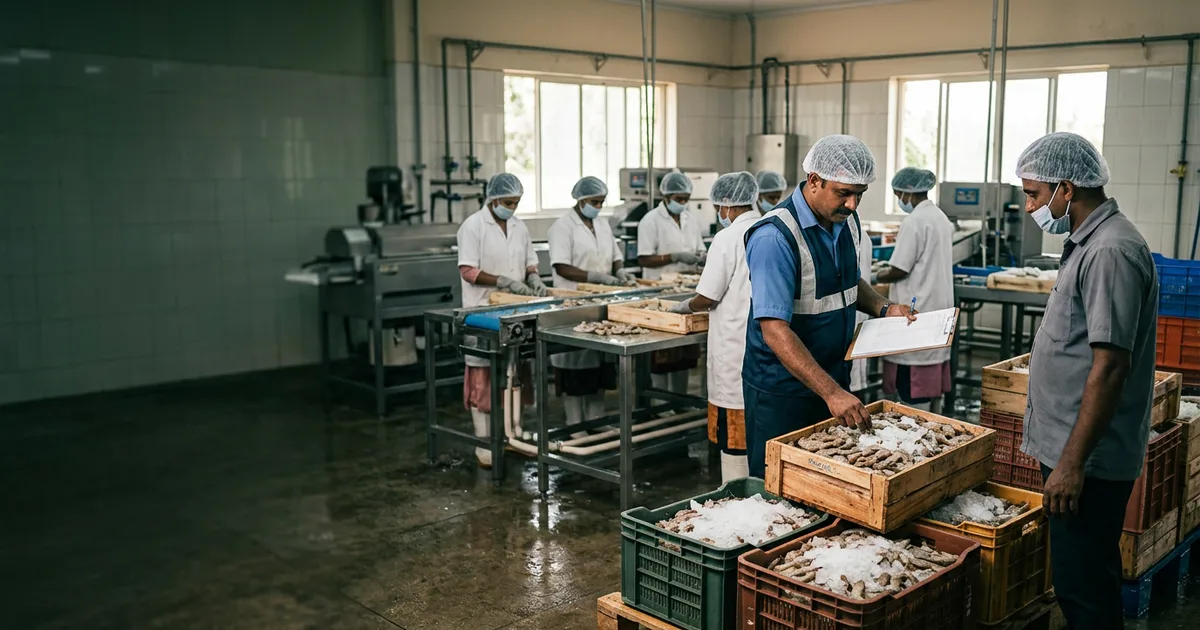
Halal certification in India is issued entirely by private certifying bodies — there is no single government-run halal authority. For Kerala's spice and seafood exporters targeting the Middle East and Southeast Asia, halal status is a market-driven requirement set by importing countries and buyers, and it sits alongside — not instead of — the mandatory government registrations every exporter in these sectors already needs: FSSAI, the Spices Board, and MPEDA.
Who actually certifies halal in India?
India has no unified government halal regulator. Certification is carried out by private, non-profit bodies, the best-established being Halal India Pvt Ltd, Jamiat Ulama-i-Hind Halal Trust, and Halal Certification Services India Pvt Ltd (HCS), among others operating regionally. The government does run one narrow accreditation framework — the India Conformity Assessment Scheme (i-CAS) for Halal, administered by the Quality Council of India, which requires halal certification bodies to be accredited by the National Accreditation Board for Certification Bodies (NABCB) against ISO/IEC 17065. Importantly, this government-recognized i-CAS scheme is currently scoped specifically to meat and meat product exports, not spices or seafood — so for Kerala's spice and seafood exporters, halal certification remains a private-agency, buyer-driven credential rather than a government-mandated one.
Why it matters for Kerala's spice and seafood exporters
Halal certification is generally not required for plant-based products like spices, grains, and pulses under most import regimes — but individual buyers, especially in Gulf and Southeast Asian markets, increasingly ask for it as a trust signal, particularly where products are used in prepared foods. Indonesia has been progressively expanding mandatory halal certification for imported food products under its Halal Product Assurance Agency (BPJPH), and Gulf states are increasingly aligning around the GSO 2055-1 regional halal standard. For seafood, most fish and shellfish are inherently halal by nature, so certification there tends to be about processing hygiene and cross-contamination controls rather than the product itself — but buyers in these markets may still request it as part of their own compliance documentation. Because requirements vary by country and even by individual buyer, exporters should confirm what a specific importer or destination market actually requires rather than assuming a blanket rule.
How halal fits alongside mandatory export certifications
Halal certification never replaces the baseline registrations Kerala's spice and seafood exporters are legally required to hold:
- FSSAI Central License — mandatory for every food export business regardless of turnover; this is the foundational food-safety license for both spice and seafood exporters.
- Spices Board Certificate of Registration as Exporter of Spices (CRES) — mandatory under Section 11 of the Spices Board Act, 1986, for anyone exporting any of the Board's scheduled spices (pepper, cardamom, ginger, turmeric, and others central to Kerala's export economy).
- MPEDA registration — mandatory under the MPEDA Act, 1972, for all commercial marine product exporters, covering fish, shrimp, prawns and other seafood; MPEDA also registers processing plants, cold storages, and fishing vessels.
- APEDA — a common point of confusion: APEDA's scheduled product list does not generally cover bulk spices or seafood (with a narrow exception for green pepper in brine). Kerala spice exporters should look to the Spices Board, and seafood exporters to MPEDA, not APEDA, as their primary registering authority.
Halal certification, where a buyer requires it, is obtained on top of these — it is a market-access add-on, not a substitute for any of them.
Key facts
- India has no single government halal authority; certification is via private, accredited agencies.
- The government's i-CAS Halal accreditation scheme (via NABCB) currently applies to meat exports, not spices or seafood.
- FSSAI, Spices Board (for spices), and MPEDA (for seafood) remain the mandatory registrations regardless of halal status.
- APEDA is generally not the relevant registering body for Kerala's spice or seafood exporters.
Because the right combination of certifications depends on your specific product and destination market, BookMyTM works with Kerala's spice and seafood exporters to identify which registrations are legally mandatory and which certifications — halal included — are worth pursuing for a given buyer relationship.
Is there a single government halal certification body in India?
No. Halal certification in India is issued by private agencies such as Halal India, Jamiat Ulama-i-Hind Halal Trust, and Halal Certification Services India — there is no unified government halal authority.
Is halal certification legally required to export spices or seafood from India?
Not under Indian law. It is typically required by specific overseas buyers or importing-country rules, particularly in Gulf and Southeast Asian markets, rather than mandated by the Indian government for these product categories.
Does MPEDA or the Spices Board issue halal certificates?
No. MPEDA and the Spices Board handle their own statutory export registrations (MPEDA registration and CRES respectively); halal certification is a separate process through private certifying agencies.
Is APEDA registration needed for Kerala spice exporters?
Generally no — spices fall under the Spices Board's scheduled list, not APEDA's, with a narrow exception for green pepper in brine. Spice exporters should register with the Spices Board (CRES).
Do I need FSSAI registration even if I already have MPEDA or Spices Board registration?
Yes. FSSAI's Central License is a separate, mandatory requirement for all food export businesses regardless of sector-specific registrations already held.