
Published 16 September 2026
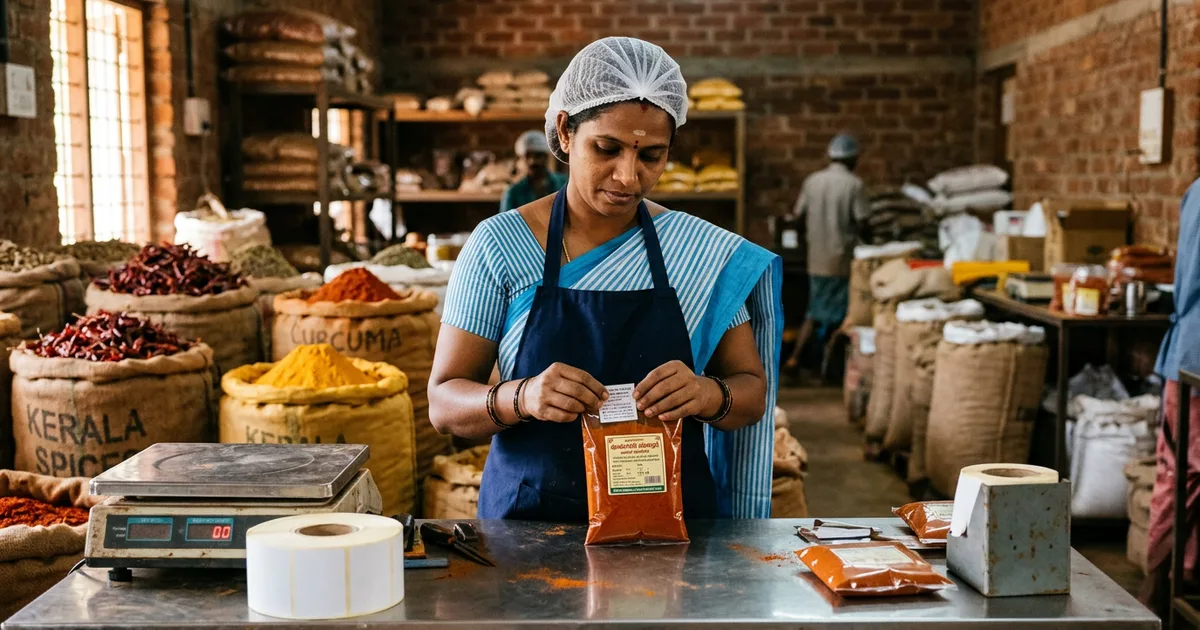
The Food Safety and Standards Authority of India notified the Food Safety and Standards (Labelling and Display) First Amendment Regulations, 2026 on 24 March 2026, and they take effect on 1 July 2027. The gap is deliberate: a food business gets roughly fifteen months to run down existing packaging stock and reprint. The amendment does not touch the front-of-pack warning-label debate, which is still unresolved. It changes what must appear on bulk and non-retail containers, relaxes the FSSAI logo rule on very small packs, redefines the nutritional-information exemptions, and rewrites two warning statements. For Kerala's spice grinders, curry-powder packers, pickle and snack makers and the coconut and cashew processors who ship to other manufacturers in bulk, the non-retail rule is the one that changes daily practice.
Non-retail containers must now carry a label
A sack of ground chilli sent from a Kochi grinder to a Mumbai masala brand, or a drum of coconut oil supplied to a soap maker, is a non-retail container: it is not sold to a consumer as it is. Under the 2020 Labelling and Display Regulations such packs could carry minimal particulars with the rest in accompanying documents; the amendment fixes what must be on the container itself. From 1 July 2027 every non-retail container must show the name of the food, the FSSAI logo and licence number, the date marking, storage instructions, the lot or batch number and the manufacturer's details, and must be clearly marked "NON-RETAIL CONTAINER" or "NOT FOR DIRECT SALE TO CONSUMER". Information that will not fit, such as the full ingredient list or the vegetarian or non-vegetarian declaration, may travel in the accompanying documents, provided those documents are traceable to the specific container. The intent is that a regulator opening the drum can trace it to a licence, a batch and a date without a phone call.
The other changes
- Small packs: a package whose surface area is 100 square centimetres or less need not carry the FSSAI logo, provided the multi-unit pack it is sold in does. Single-serve sachets of pickle, chutney or masala are the obvious beneficiaries.
- Minimally processed foods are defined: cereals, pulses, fruits, vegetables and single-ingredient products that have only been cleaned, ground, refrigerated, pasteurised, fermented, frozen or vacuum-packed, without substantially changing their nutritional value. These are treated differently for nutritional labelling, which matters for a unit packing whole spices, rice or pulses.
- Infant nutrition products no longer have to declare the per-serve percentage contribution to the Recommended Dietary Allowance or the number of servings per pack.
- Low-energy health supplements and foods for special dietary use sold as tablets or capsules get refined nutritional-information exemptions.
- Fortified foods must declare "fortified with" followed by the name of the fortificant and carry the prescribed logo; the tagline "Sampoorna Poshan Swasth Jeevan" is optional.
- Artificial-sweetener warnings are reworded: products containing aspartame-acesulfame salt must state they are not recommended for children and for pregnant or lactating women; "pregnant and lactating mothers" becomes "pregnant or lactating women" throughout, and a combination of sweeteners needs the statement once, not repeated.
- Pan masala advertisements must carry a clearly legible or audible warning.
Why the non-retail rule matters more in Kerala
A large share of the state's food output leaves the factory in bulk. Spice grinders in Ernakulam and Thrissur supply masala brands elsewhere in India; coconut processors supply oil, desiccated coconut and milk powder to confectioners and cosmetic makers; cashew units in Kollam ship kernels in 25-kilogram tins; and jaggery, banana chips and tapioca products move to repackers by the sack. Each of those consignments becomes a labelled, traceable unit under the amendment. The customer at the other end, typically a licensed manufacturer, will begin demanding the marked container and the traceable documents well before July 2027, because their own audit depends on it. Exporters are less affected, since export consignments follow the buyer's country rules, but the same documents feed the traceability an EU or Gulf importer already asks for.
A reprint plan for the next fifteen months
- List every pack format the unit uses, retail and non-retail, and mark which ones are 100 square centimetres or smaller, which are bulk, and which carry sweeteners or fortificants.
- Design the non-retail label now: name, licence number, date marking, storage, batch, manufacturer, and the mandatory marking, and decide which items will travel in the delivery documents instead.
- Tie the batch number on the label to the batch record in the plant's HACCP or ISO 22000 system, since traceability is what the rule is testing.
- Sequence the reprint so that existing retail artwork is used up before the new plates are cut; the amendment does not require destroying compliant stock before 1 July 2027.
- Re-check the artwork against the unamended 2020 Regulations as well, including the vegetarian or non-vegetarian symbol, allergen declaration and font-size rules, which the amendment leaves in force.
Frequently Asked Questions
When do the 2026 FSSAI labelling amendments take effect?
On 1 July 2027. The Food Safety and Standards (Labelling and Display) First Amendment Regulations, 2026 were notified on 24 March 2026 with a transition period for existing packaging.
What must a non-retail container show from July 2027?
The name of the food, FSSAI logo and licence number, date marking, storage instructions, lot or batch number and manufacturer details, with the marking "NON-RETAIL CONTAINER" or "NOT FOR DIRECT SALE TO CONSUMER"; remaining particulars may be in traceable accompanying documents.
Do small sachets still need the FSSAI logo?
Not if the package surface area is 100 square centimetres or less and the multi-unit pack it is sold in carries the logo.
Does the amendment introduce front-of-pack warning labels?
No. Front-of-pack nutrition labelling remains a separate, unresolved proposal; this amendment concerns non-retail containers, exemptions, fortification declarations and warning statements.
Does the amendment apply to spice exporters?
Export consignments are labelled to the importing country's requirements, but domestic bulk supply to other Indian manufacturers falls squarely under the non-retail rule.
Sources
Food Safety and Standards Authority of India, Food Safety and Standards (Labelling and Display) First Amendment Regulations, 2026, notified 24 March 2026, in force 1 July 2027 (FSSAI gazette notifications); Food Safety and Standards (Labelling and Display) Regulations, 2020; summaries by ChemLinked, myfssai.in and foodsafetystandard.in cross-checked against each other. Confirm the regulation text for your product category before reprinting.
BookMyTM handles FSSAI licensing, label reviews and ISO 22000 certification for food processors, spice packers and exporters across Kerala.