
Published 16 September 2026
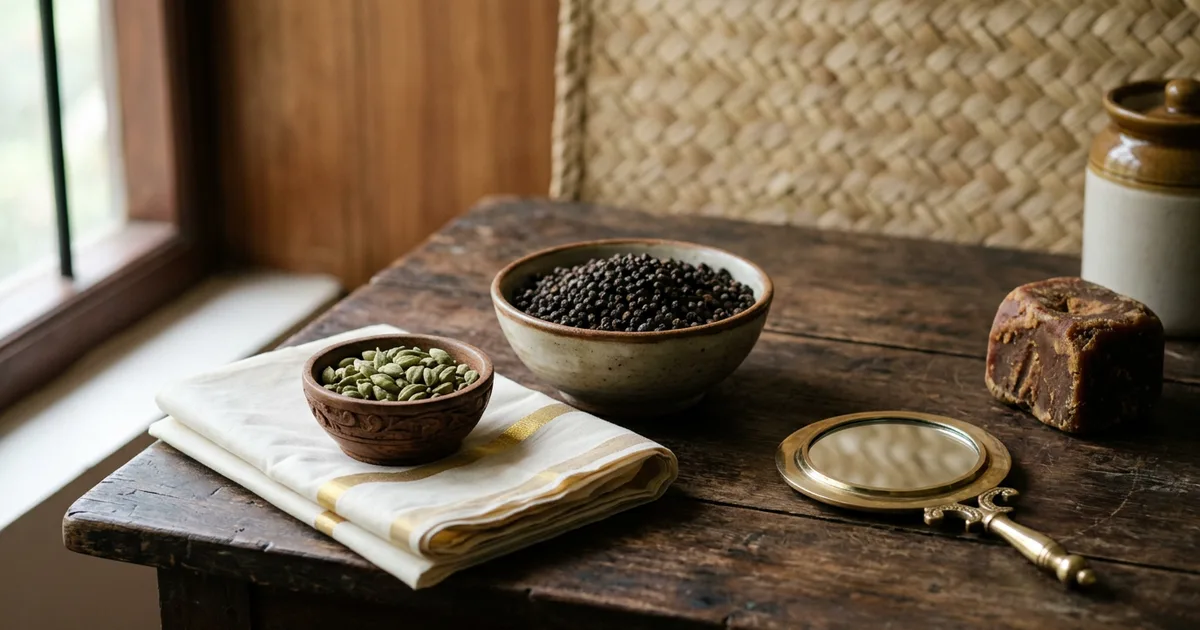
A geographical indication is a registered sign that identifies goods as originating in a particular place, where a given quality, reputation or characteristic is essentially attributable to that origin. Alleppey Green Cardamom, Aranmula Kannadi and Palakkadan Matta rice are GIs; a brand name is not. Kerala's Directorate of Industries and Commerce lists 31 registered GIs from the state, and the number has kept growing: Kannadippaya, the reed mat woven by tribal communities in Idukki and neighbouring districts, was registered in 2025 as Kerala's first tribal handicraft GI. The Geographical Indications (Amendment) Rules, 2025, notified on 3 November 2025, cut the application fee from five thousand rupees to one thousand rupees per class, which removes the last cost objection a producer group might have had. This post lists what Kerala already holds and walks through the application.
What Kerala has registered
- Spices and plantation: Malabar Pepper, Alleppey Green Cardamom, Wayanad Robusta Coffee, Tirur Betel Leaf, Edayur Chilli.
- Rice and grain: Palakkadan Matta, Navara, Pokkali, Kaipad, Wayanad Jeerakasala and Wayanad Gandhakasala rice; Attappady Thuvara (red gram) and Attappady Attukombu Avara (dolichos bean).
- Fruit and vegetables: Vazhakulam Pineapple, Chengalikodan Nendran banana, Kuttiattoor Mango, Kodungallur Pottuvellari (snap melon), Onattukara Ellu (sesame), Kanthalloor-Vattavada Veluthulli (garlic).
- Jaggery: Marayoor Jaggery, Central Travancore Jaggery.
- Textiles: Balaramapuram sarees and fine cotton fabrics, Kasaragod sarees, Kuthampully sarees, Kuthampully dhoties and set mundu, Chendamangalam dhoties and set mundu, Cannanore home furnishings.
- Handicrafts and manufactured goods: Aranmula Kannadi, Palakkad Maddalam, Payyanur Pavithra Ring, Screw Pine craft, brass-broidered coconut shell craft, Alleppey Coir, Kannadippaya.
- Forest produce: Nilambur Teak, the first forest produce in India to be registered as a GI.
What registration gives a producer
A GI is owned collectively, not by a company. The applicant is an association of producers, a cooperative, a producer company or a government body acting for them, and the individual farmer or artisan then registers as an authorised user to use the GI on their goods. Registration under the Geographical Indications of Goods (Registration and Protection) Act, 1999 lasts ten years and is renewable indefinitely. It gives the right to prevent anyone outside the region, or inside it but not meeting the specification, from using the name, and it gives the false-application and selling offences under sections 39 to 41 of the Act, which remain criminal after both Jan Vishwas Acts. Commercially the tag is what lets Marayoor jaggery or Wayanad coffee command a price above the commodity, and it is what an exporter's buyer in the EU asks for when they want origin on the label.
The application, step by step
- Form the applicant body: a registered society, cooperative, trust or producer company that represents the producers, with a constitution that says so. Kerala's District Industries Centres, the Kerala Agricultural University and the Kerala Bureau of Industrial Promotion have all sponsored past applications.
- Prepare the statement of case: the geographical area with a map, the history of the product in that area, the specific quality or characteristic and how it arises from the place, the method of production, and the inspection body that will police the specification.
- File Form GI-1 with the Geographical Indications Registry in Chennai, in the class or classes of the Nice Classification the goods fall in, with the fee of one thousand rupees per class under the 2025 Rules.
- Examination and consultative group: the Registry examines the application and refers it to a consultative group of experts; deficiencies come back as an examination report to be answered.
- Publication in the Geographical Indications Journal, with a three-month period for opposition.
- Registration and certificate, after which producers apply individually as authorised users on Form GI-3, a nominal fee since the 2020 amendment.
- Renewal every ten years, now five hundred rupees under the 2025 Rules.
Where Kerala applications go wrong
Three faults recur. The area is drawn too widely, to include every taluk that wants in, and the link between place and quality collapses. The specification is written from memory rather than measurement, so the inspection body has nothing to test against. And the authorised-user step is forgotten after registration, leaving a tag with a handful of registered users and a market full of unregistered ones. A GI is only as valuable as the enforcement behind it, and enforcement starts with a specification that a laboratory or an inspector can check.
Frequently Asked Questions
How many GI-tagged products does Kerala have?
The Directorate of Industries and Commerce lists 31 registered GIs from Kerala; later registrations such as Kannadippaya in 2025 have added to the list. Check the GI Registry's register for the current count.
What does a GI application cost in 2026?
One thousand rupees per class for the application on Form GI-1, reduced from five thousand by the Geographical Indications (Amendment) Rules, 2025; renewal is five hundred rupees.
Can an individual farmer or company register a GI?
No. The applicant must be an association of persons, producers, organisation or authority representing the producers' interests. Individual producers register afterwards as authorised users.
How long does a GI registration last?
Ten years from registration, renewable for further ten-year periods indefinitely.
Is misusing a GI a criminal offence?
Yes. Falsely applying a GI and selling goods bearing a false GI remain offences under sections 39 to 41 of the Act, with imprisonment of six months to three years; the 2023 Jan Vishwas Act converted only the false-representation offence in section 42 into a penalty.
Sources
Geographical Indications of Goods (Registration and Protection) Act, 1999, sections 11, 18, 21 and 39 to 42; Geographical Indications of Goods (Registration and Protection) (Amendment) Rules, 2025, notified 3 November 2025, and the 2020 amendment (G.S.R. 528(E), 26 August 2020); Directorate of Industries and Commerce, Government of Kerala, Kerala GI products page and the Kerala Bureau of Industrial Promotion's gikerala.in listing; Kerala Forest Research Institute and Onmanorama on the Kannadippaya registration. Product lists change; confirm on the GI Registry before citing.
BookMyTM prepares GI applications and authorised-user registrations for producer groups in Kerala, from the statement of case to the inspection structure.