
Published 15 October 2026
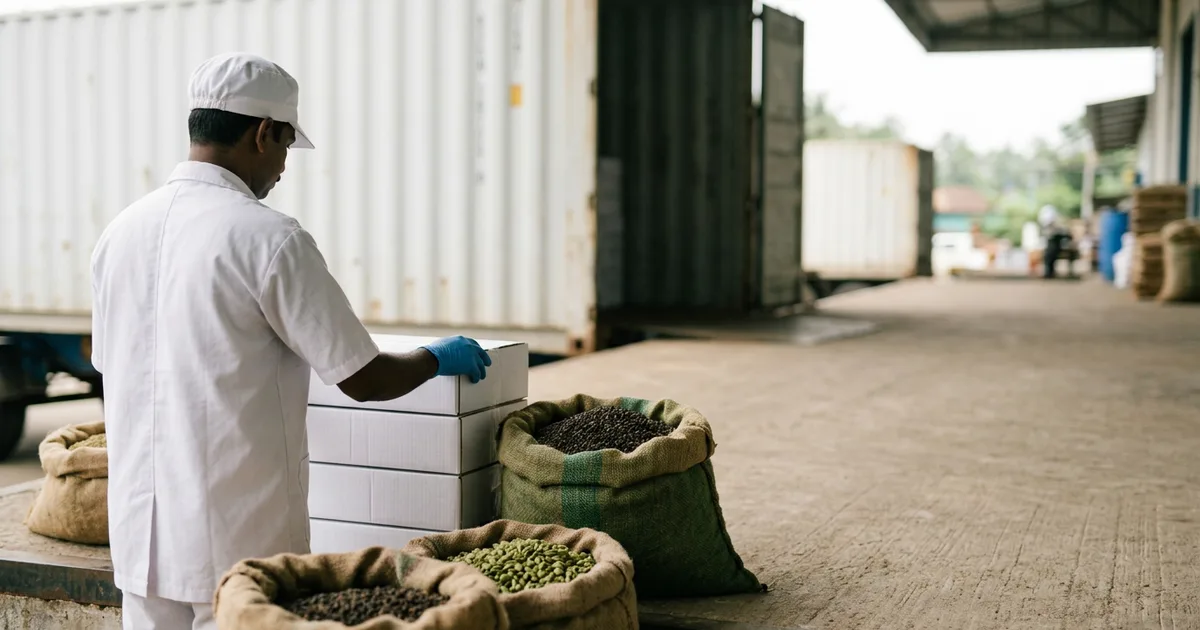
On 11 September 2026 the European Commission sent the Council of the EU its proposals for the signing and conclusion of the India–EU Free Trade Agreement, whose negotiations closed on 27 January 2026. For Keralam, where seafood processors around Kochi and spice traders from Idukki to Wayanad sell into Europe, it is one of the most consequential trade agreements in years. It is also not yet in force: the duty cuts begin only when the agreement takes effect, and for some shrimp products the cut is a quota rather than zero duty. Here is what India's own factsheet says, and what exporters can do before the date arrives.
What India gets on tariffs
- Preferential access on 97 per cent of the EU's tariff lines, covering 99.5 per cent of trade value, according to the Commerce Ministry.
- Immediate elimination, from entry into force, on 70.4 per cent of tariff lines covering 90.7 per cent of India's exports, with tea, coffee, spices and certain marine products named among the sectors.
- Zero duty over three to five years on a further 20.3 per cent of lines, covering 2.9 per cent of exports, including certain marine products and processed foods.
- Tariff reductions or tariff-rate quotas, rather than full elimination, on 6.1 per cent of lines, covering 6 per cent of exports; the ministry lists certain shrimp and prawn products in this group.
For context, the factsheet puts the EU's current duties on India's labour-intensive exports, marine products among them, at between 4 and 26 per cent.
What that means for Kerala's main exports
- Spices such as pepper and cardamom: in the immediate-elimination group, so duty-free from the first day the agreement applies, subject to rules of origin.
- Seafood: split. Certain marine products go duty-free immediately, others over three to five years, and certain shrimp and prawn lines get a quota or a reduced duty. Each product has to be checked by its tariff line in the published schedule.
- Coffee and tea: named in the immediate group, relevant to Wayanad's coffee growers and the State's tea estates.
- Food safety: tariff preference does not relax EU sanitary rules. Residue limits, approved-establishment listing and health certificates apply exactly as now, so the documentation work does not go away.
When could the cuts start?
After the Commission's proposals, the Council has to authorise signature; the agreement is then signed, the European Parliament must give its consent, and the Council concludes it for the EU side, while in India the Union Cabinet approves it. Both sides have spoken of signing by the end of 2026, but no date for entry into force has been fixed, and until it is, EU duties apply in full. Treat the figures above as the destination, not the current position.
Rules of origin: where preferences are won or lost
Zero duty applies only to goods that qualify as Indian-originating under the agreement's rules. India's factsheet says exporters will be able to self-certify origin, which shifts the burden onto the exporter's own records: catch and farm documents for seafood, purchase records for spices, and processing records where imported inputs are used. An importer in the EU claiming the preference can be asked for proof, so the exporter's files must stand up to verification.
Five things to do before the agreement applies
- Map every product to its EU tariff line and find its tranche once the schedules are public: immediate, phased, or quota.
- Set up origin records now: supplier declarations, catch or farm certificates and bills of material that show why each consignment qualifies.
- Keep EU food-safety approvals, establishment listings and laboratory testing current; they decide market access regardless of duty.
- Price contracts with the duty cut in mind but conditioned on the entry-into-force date, so neither side bets on a date that slips.
- Protect your brand in Europe before you scale up: an EU trademark through the Madrid Protocol from India, so that the name on your cartons cannot be registered first by someone else.
What about geographical indications?
When India and the EU relaunched talks in 2022 they opened three separate negotiations: the free trade agreement, an investment protection agreement and an agreement on geographical indications. Protection in Europe for names like Malabar pepper or Alleppey green cardamom therefore depends on the GI track, not on the tariff deal.
Frequently Asked Questions
Is the India–EU free trade agreement in force?
No. Negotiations concluded on 27 January 2026 and the European Commission sent its proposals for signature and conclusion to the Council on 11 September 2026. Duty cuts begin only from entry into force.
Will spices from Kerala become duty-free in the EU?
Spices are in the group that India's Commerce Ministry lists for immediate elimination, so qualifying spices would be duty-free from entry into force, subject to the rules of origin.
Will Indian shrimp be duty-free in the EU?
Not all of it. Certain marine products go duty-free immediately or over three to five years, but certain shrimp and prawn products are in the group that gets tariff reductions or tariff-rate quotas.
What are the EU's duties on Indian seafood now?
India's factsheet puts current EU duties on its labour-intensive exports, including marine products, at between 4 and 26 per cent, depending on the product.
How will exporters prove origin?
India's factsheet says the agreement allows self-certification of origin, so exporters must keep records that show each consignment meets the product-specific rules.
Sources
Ministry of Commerce and Industry, factsheet on the India–EU trade deal, January 2026, and the PIB release on its conclusion; All India Radio News, 11 September 2026, on the Commission's proposals to the Council; European Parliament Legislative Train Schedule, "EU-India FTA, BIT and GI agreement"; Onmanorama, 28 January 2026.
BookMyTM supports Kerala exporters with ISO 22000 and ISO 14001 certification, export registrations and international trademark filings under the Madrid Protocol.