
Published 16 September 2026
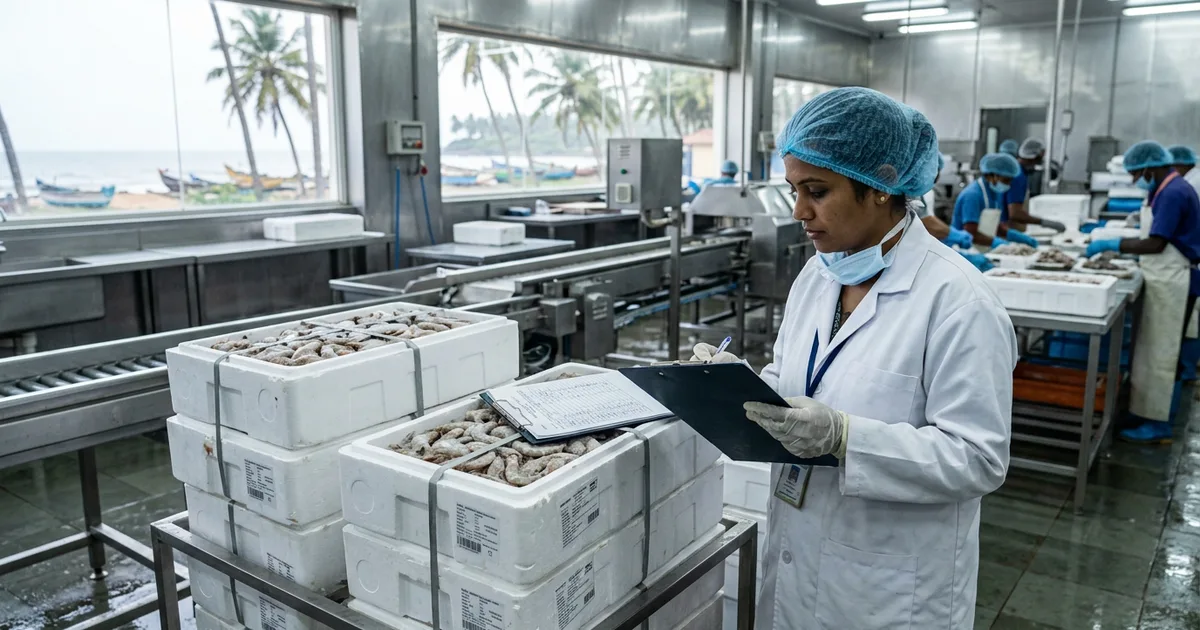
From 3 September 2026, a consignment of farmed shrimp, fish, honey, eggs or animal casings can enter the European Union only from a country on the EU's list of third countries that have given official guarantees about antimicrobial use in food-producing animals, and only with an attestation of that compliance on its health certificate. India is on the list. Commission Implementing Regulation (EU) 2026/1189, adopted on 4 June 2026 and published the next day, amended the EU's country list in Regulation (EU) 2021/405 to include India for aquaculture products, eggs, honey and animal casings. It was not a formality: the earlier list, Implementing Regulation (EU) 2024/2598 of October 2024, had left India out. For Kerala, home of the Marine Products Export Development Authority and among India's largest seafood-exporting states, the listing preserves access to a market worth about 1.59 billion US dollars a year, and it changes what every consignment has to carry.
Where the requirement comes from
Regulation (EU) 2019/6 on veterinary medicinal products prohibits, inside the EU, the use of antimicrobials to promote growth or increase yield, and the use of antimicrobials reserved for the treatment of infections in humans. Article 118 of that regulation extends the same prohibitions to animals and animal products imported from outside the EU. Commission Delegated Regulation (EU) 2023/905 set out how that would be enforced: from 3 September 2026, exporting countries must be on a list confirming they have provided official guarantees of compliance, and consignments must carry an official attestation. Regulation (EU) 2026/1189 is the listing decision and repeals the 2024 list. Countries left off it lose EU access for the products concerned from that date.
What India had to show
Listing required India to satisfy the European Commission that its official control system could guarantee the two prohibitions across the supply chain: no antimicrobials used for growth promotion in farmed animals destined for the EU, and no use of the antimicrobials the EU reserves for human medicine. The Department of Commerce led the engagement with the Commission. The Export Inspection Council, India's competent authority for export certification, strengthened its official control system through what it describes as enhanced inspection, testing and certification mechanisms aligned with EU rules, alongside the National Residue Control Programme, post-harvest testing and surveillance for banned antibiotics. MPEDA, headquartered in Kochi, works with the EU-approved processing establishments on the ground. India appeared in the Commission's revised draft list published on 12 May 2026, and the regulation followed on 4 June.
What changes for a Kerala exporter
- The health certificate accompanying each consignment now includes an antimicrobial attestation. It is issued through the Export Inspection Council's certification system, so an exporter's EU-bound shipments run through EIC's official control and not only MPEDA registration.
- Farm-level guarantees matter as much as plant-level ones. The prohibition attaches to the animals, so an approved processing plant sourcing from farms that cannot show antimicrobial records puts the whole consignment, and the establishment's approval, at risk.
- Antimicrobials reserved for human use are the sharper edge. Residue testing for growth promoters was already routine; the list of human-reserved substances is specific and an exporter's residue-monitoring plan should name them.
- Traceability from farm to container has to be documentary, not just physical: farm registration, feed and treatment records, and batch linkage that an EIC inspector can follow and an EU border post can query.
- The listing is not permanent. The EU reviews compliance and can amend the list, as it did between the 2024 and 2026 regulations; India's exclusion from the first list shows how quickly access can be in question.
Why it matters more in Kerala than most states
India's seafood exports reached a record 8.46 billion US dollars in 2025-26, and the EU was the third-largest market at 18.94 per cent of value, about 1.593 billion US dollars, up 41.45 per cent in value and 38.29 per cent in quantity on the previous year, with farmed shrimp the largest item. Kerala's processing industry, concentrated around Kochi, Alappuzha and Kollam, is disproportionately exposed: the state has a long coastline, a dense cluster of EU-approved establishments and a shrimp-farming base in the backwaters that supplies them, and the EU has historically been a steadier market for Kerala's product mix than the tariff-hit United States. A processing plant in Aroor that loses its EU approval does not have an easy alternative buyer for the same volume.
The checklist before the next EU consignment
- Confirm the establishment's EU approval number is current and that the EIC has issued the new-format health certificate with the antimicrobial attestation for it.
- Obtain and file written declarations from every supplying farm on antimicrobial use, and add the EU's human-reserved antimicrobials to the residue-testing plan by name.
- Map traceability from farm registration to export batch, and test it by following one container's paperwork backwards.
- Brief the buyer: EU importers are being asked by their own authorities for the attestation, and a consignment that arrives without it will be held.
- Keep the ISO 22000 or HACCP system's document control aligned with the new certificate; a mismatch between plant records and certificate is the kind of gap an audit finds.
Frequently Asked Questions
Can India still export shrimp and fish to the EU after September 2026?
Yes. Commission Implementing Regulation (EU) 2026/1189, adopted on 4 June 2026, includes India in the EU's list of countries authorised to export aquaculture products, eggs, honey and animal casings under the antimicrobial rules that apply from 3 September 2026.
What is the EU antimicrobial requirement?
Under Article 118 of Regulation (EU) 2019/6, animals and animal products imported into the EU must not have been given antimicrobials for growth promotion or antimicrobials reserved for human medicine. Delegated Regulation (EU) 2023/905 makes listing and an attestation on the health certificate compulsory from 3 September 2026.
Which Indian authority issues the certificate?
The Export Inspection Council, India's competent authority for export certification, whose official control system was strengthened for the listing. MPEDA in Kochi works with the EU-approved establishments.
Does the rule apply to wild-caught fish?
The antimicrobial prohibitions concern food-producing animals that can be treated, so farmed aquaculture is the focus; the EU lists countries for aquaculture products. Exporters of mixed product should confirm certificate requirements per product with EIC.
How much does Kerala export to the EU?
India's seafood exports to the EU were about 1.593 billion US dollars in 2025-26, 18.94 per cent of the country's seafood export value, and Kerala is one of the largest exporting states with its industry clustered around Kochi.
Sources
Commission Implementing Regulation (EU) 2026/1189 of 4 June 2026 amending Regulation (EU) 2021/405 and repealing Regulation (EU) 2024/2598 (EUR-Lex); Commission Delegated Regulation (EU) 2023/905 applying from 3 September 2026; Regulation (EU) 2019/6, Article 118; Ministry of Commerce and Industry press release of 8 June 2026 (PIB); MPEDA export statistics for 2025-26 as reported by Business Standard and The Tribune. Product-specific certificate requirements should be confirmed with the Export Inspection Council.
BookMyTM supports Kerala's seafood and food exporters with ISO 22000 and ISO 14001 certification, export registrations and the documentation systems that EU-facing audits examine.