"I want to register my startup."
We hear this phrase ten times a day at BookMyTM. And invariably, our next question is: "Register for what? For Tax benefits or for Brand protection?"
The founder usually pauses. "Wait, aren't they the same thing?"
No. They are not.
There is a massive confusion in the Indian ecosystem between Startup India Registration (DPIIT) and Trademark Registration. While they sound like similar bureaucratic steps, they serve completely different purposes, are governed by different ministries, and offer radically different benefits.
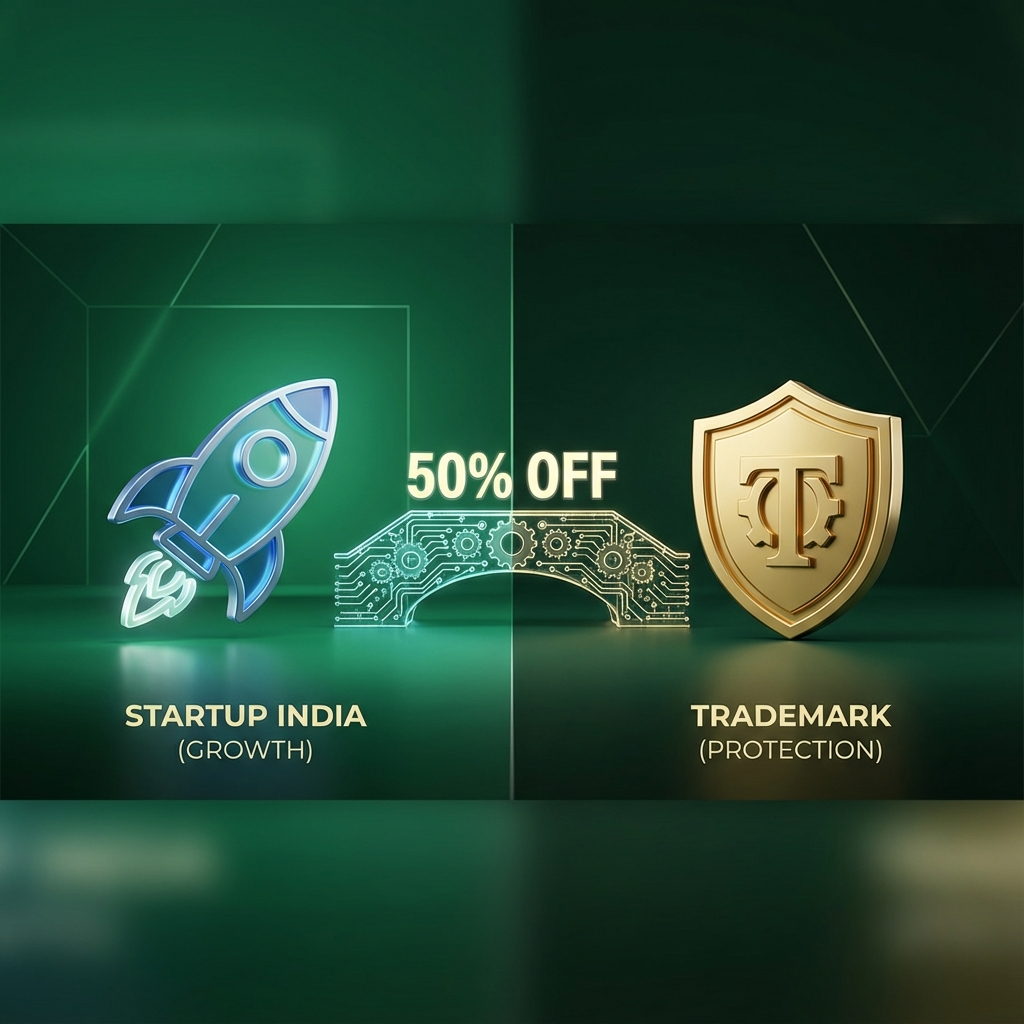
However, there is a secret link between them. If you have one, you get a massive discount on the other.
In this detailed 1500-word guide, we unravel the mystery. We will explain what each registration does, why you probably need both, and how to use them together to save thousands of rupees.
The BookMyTM Hack
"Get the Startup India certificate first. It acts like a 50% Discount Coupon for every trademark application you file thereafter."
1. The Tale of Two Registrations
Let’s start with the basics. Who runs the show?
Contender 1: Startup India (DPIIT)
Governing Body: Department for Promotion of Industry and Internal Trade (Ministry
of Commerce).
Goal: To boost entrepreneurship, create jobs, and foster innovation.
What you get: A "Recognition Certificate" that says you are a bona fide
startup.
Contender 2: Trademark Registration
Governing Body: Controller General of Patents, Designs and Trademarks (IP India).
Goal: To protect intellectual property rights.
What you get: A Legal Title (Registration Certificate) proving you own your
brand name.
2. Why do you need Startup India? (The Money Angle)
Startup India is primarily about Growth & Taxes. It is a government scheme designed to make your life easier.
Key Benefits:
A. The "Angel Tax" Shield
Investments raised by startups from angel investors were historically taxed. DPIIT recognition gives you an exemption from Section 56(2)(viib) of the Income Tax Act.
B. The 3-Year Tax Holiday (Section 80-IAC)
This is the holy grail. Eligible startups can apply for a 100% Income Tax Exemption
for 3 consecutive years out of their first 10 years.
Note: Just getting the DPIIT certificate is not enough. You need to clear a second
round of scrutiny by the Inter-Ministerial Board (IMB). It is tough, but worth it.
C. Easier Tenders
Government tenders usually have strict criteria like "Minimum experience of 5 years" or "Turnover of ₹50 Crores". For DPIIT startups, these norms are relaxed. You can bid even if you started yesterday.
3. Why do you need a Trademark? (The Identity Angle)
Trademark is about Ownership & Defense. It has nothing to do with your taxes, but everything to do with your survival.
Key Benefits:
A. Legal Monopoly
Once registered, you have the exclusive right to use your brand name in your industry. If anyone copies you, you can sue them for damages.
B. Asset Creation
A trademark is an intangible asset. You can sell it, franchise it (like McDonald's), or license it. It adds valuation to your balance sheet.
C. Trust Signal
The ® symbol tells customers (and investors) that you are serious. It builds instant credibility.
4. The "Secret Connection": How to save 50%
Here is the hack that every smart founder uses.
The Government wants to encourage startups to protect their IP. So, they created a special provision:
If you hold a valid Startup India Certificate, the Government Fee for Trademark filing is SLASHED by 50%.
The Math:
- Regular Company Fee: ₹9,000 per class.
- Startup / MSME Fee: ₹4,500 per class.
Savings: ₹4,500 per application. If you file in 2 classes (e.g., Logo + Word), you save ₹9,000 instantly. That is enough to cover your coffee budget for a few months!
5. Comparison Table: At a Glance
Goal: Tax Benefits (Startup India) vs Brand Protection (Trademark).
Validity: 10 Years (Startup India) vs 10 Years Renewable (Trademark).
Key Benefit: Funding/Tax (Startup India) vs Exclusive Rights (Trademark).
6. Which one should you do first?
This is the classic "Chicken and Egg" problem.
Option A: The "Saver" Route
1. Incorporate your Pvt Ltd company.
2. Apply for Startup India Recognition (Takes 2-4 weeks).
3. Use the Certificate to file Trademark at ₹4,500.
Option B: The "Protector" Route (Recommended)
1. File Trademark immediately as an Individual (Fee: ₹4,500).
2. Incorporate the company later.
3. Transfer the Trademark to the company (Assignment).
BookMyTM Verdict: IP is time-sensitive. Do not wait for bureaucratic certificates to protect your brand. File the trademark as soon as you have a name. You can claim MSME benefits to get the same discount even without Startup India.
7. The Verification Trap
Be careful. Just having a "UDYAM Registration" (MSME) is NOT the same as Startup India.
UDYAM = MSME Ministry (Small Business).
DPIIT = Commerce Ministry (Innovation Startup).
While both give you the 50% trademark discount, only DPIIT gives you
the Income Tax Holiday and Angel Tax exemption. Don't mix them up.
Conclusion: You Need Both
Asking "Startup India vs Trademark" is like asking "Left leg vs Right leg". You need both to run.
Use Startup India to fuel your growth (save taxes, get funding).
Use Trademark to protect the value you create with that growth.
If you build a multi-crore business but forget the trademark, a copycat will steal your customers. If you have a trademark but miss Startup India, you leave free government money on the table.
Get the best of both worlds.
At BookMyTM, we offer a "Startup Launchpad" package. We handle your
Incorporation + Startup India Registration + Trademark Filing in one seamless workflow.