Imagine this scenario: You start a coffee shop called "BrewMasters". You register the trademark in Class 30 (which covers Coffee and Tea). You feel safe.
Six months later, another company opens a marketing agency called "BrewMasters Digital" and registers it in Class 35. You try to sue them, but the judge throws your case out. Why? Because you registered for the product (Coffee), but they registered for the service (Marketing). According to the law, you are not competitors.
This is the tricky, often misunderstood world of Trademark Classes.
If the Trademark Act is the "Bible" of brand protection, the NICE Classification is the map. It divides the entire universe of possible products and services into 45 specific classes. Be it a Tesla car, a McDonald's burger, or a YouTube channel, everything falls into one of these numbered buckets.
In this comprehensive 1500-word guide, BookMyTM demystifies the classification system. Whether you are a SaaS founder, a fashion designer, or a restaurant owner, this article will help you find your number and avoid costly filing mistakes.
The BookMyTM Rule
"Choosing the wrong class is worse than not registering at all. It gives you a false sense of security while leaving your actual business exposed."
1. What is the NICE Classification?
The NICE Agreement, established in 1957 in Nice, France, is an international system used to classify goods and services for trademark registration. India, being a signatory, follows this exact system.
The logic is simple: A trademark does not give you a monopoly over a word for everything. It only protects that word in relation to the specific category of things you sell.
The 45 Classes are split into two broad groups:
Classes 1 to 34: GOODS (Physical Products)
Classes 35 to 45: SERVICES (Intangible Activities)
2. The "Startup Essentials": Most Common Classes
While there are 45 classes, 80% of modern startups generally fall into these 5 key buckets. Let’s break them down.
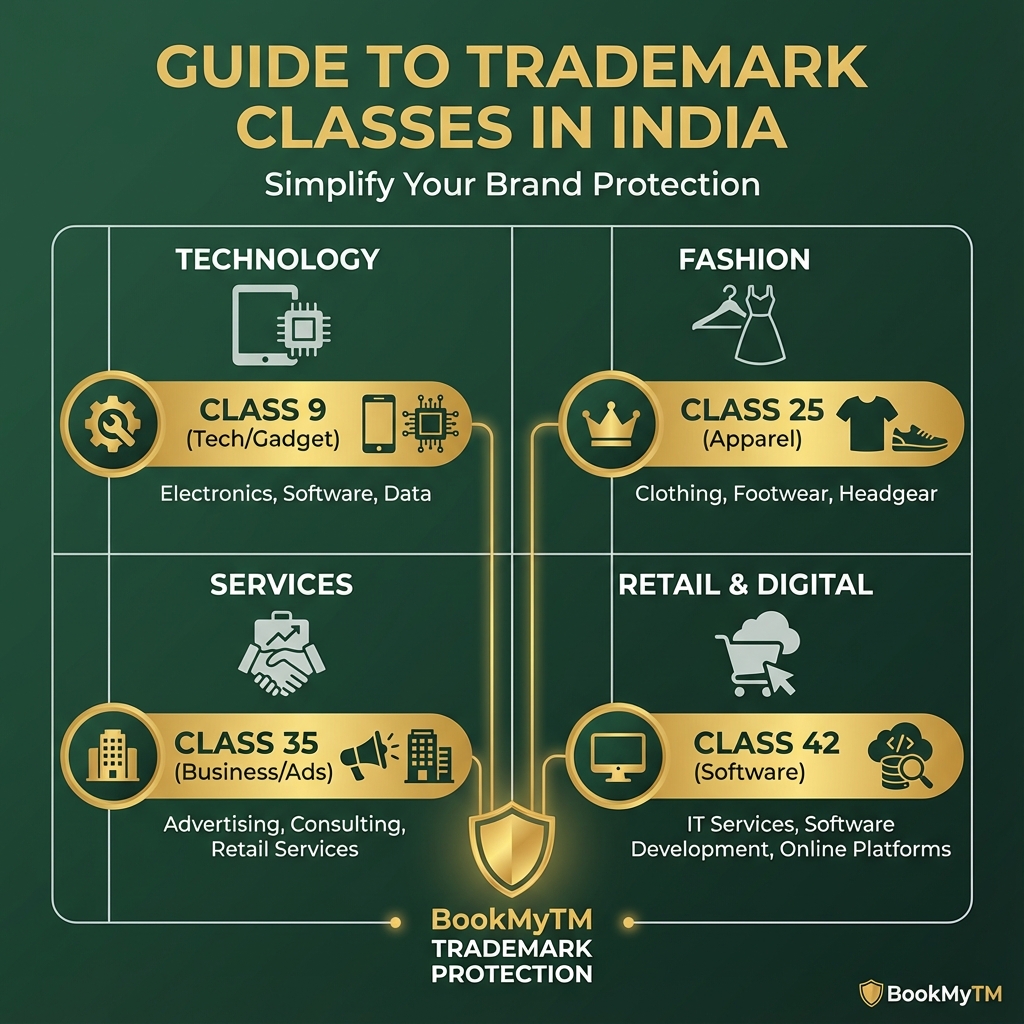
Class 9: The "Tech & Electronics" Giant
This is arguably the most crowded class in the 21st century. It covers almost anything that has a
screen or a circuit board.
Includes: Mobile Apps (Downloadable), Software, Computer Hardware, Sunglasses,
Scientific Instruments.
Who needs it? Every SaaS company, App developer, Electronics seller.
Class 35: The "Business & Retail" Catch-all
Often called the "Mother of all Classes", Class 35 is necessary for almost everyone who has a shop
or an agency.
Includes: Advertising, Business Management, Retail Stores, E-commerce Marketplaces,
Wholesale.
Who needs it? Marketing Agencies, Consultants, and importantly,
Aggregators (like Amazon/Flipkart sellers).
Class 25: The "Fashion" Hub
If you can wear it, it goes here.
Includes: Clothing, Footwear, Headgear.
Note: It does NOT cover Handbags (Class 18) or Jewellery (Class 14).
Class 41: Education & Entertainment
With the boom in EdTech and Creator Economy, this class is surging.
Includes: Training specific services, Events, YouTube Channels, Podcasts, Schools,
Publishing.
Class 42: The "Coder's" Class
This is the sister to Class 9. While Class 9 protects the downloadable app code, Class 42
protects the service of coding.
Includes: SaaS (Software as a Service), Cloud Computing, IT Consulting.
3. The "Product vs. Service" Dilemma (Class 30 vs 43)
This is where 40% of food businesses get it wrong. Let's look at the distinction.
Class 30 (Goods): Coffee, Tea, Rice, Spices, Bakery items.
Class 43 (Services): Restaurants, Cafes, Hotels, Catering.
- If you sell Packaged Coffee Powder on Amazon: You need Class 30.
- If you run a Cafe where people sit and drink coffee: You need Class 43.
- If you do BOTH (like Starbucks): You must register in Class 30 AND Class 43.
4. Multi-Class Applications (Form TM-M)
In India, you can file a single application for multiple classes. This saves paperwork but not money.
- Cost: Government fees differ. It is ₹4,500 per class.
- So, filing in Class 9, 35, and 42 = ₹4,500 x 3 = ₹13,500.
- Risk: If one class faces an objection, the entire application gets stuck.
BookMyTM Strategy: We often recommend filing separate applications for each class. That way, if Class 9 gets objected but Class 35 is clear, at least you get the registration for Class 35 quickly without it being held hostage.
5. How to Choose the Right Class (The Search Tool)
Never guess your class. The IP India website has a tool called the "Class Details". Here is how to use it:
- Go to the IP India Public Search.
- Click on "Class Details".
- Type your product keyword (e.g., "Candles").
- The system will tell you it falls under Class 4.
Warning: Some terms are tricky.
"Software" is Class 9.
"Software update services" is Class 42.
"Curtains" are Class 24 (Textiles).
"Bamboo Curtains" are Class 20 (Furniture).
Details matter. One wrong word in your description can lead to a refusal.
6. What if I Cross-Expand Later?
"I sell Shoes (Class 25) now, but I might sell Perfumes (Class 3) in 2030. Should I register both now?"
The "Defensive Filing" Debate:
Pros: Prevents squatters from taking your name in related categories.
Cons: Indian law requires "Intent to Use". If you don't use the mark in Class 3
for 5 years, any competitor can file for "Non-Use Cancellation" and strip you of that trademark.
Our Advice: Only register classes you intend to start within the next 3 years.
7. The 2025 Update: New Virtual Goods Classes
The metaverse has disrupted the NICE classification.
NFTs and Virtual Goods: Are now generally categorized under Class
9 (Downloadable virtual goods).
Virtual Retail Services: Are categorized under Class 35.
If you are a web3 startup, you cannot just use standard definitions. You need custom drafting to ensure your digital assets are protected.
Conclusion: Precision Saves Money
Choosing the right class is the foundation of your trademark strategy.
Choose too few classes? You leave gaps for copycats.
Choose too many classes? You waste thousands of rupees and risk non-use cancellation.
Choose the wrong class? Your certificate becomes a worthless piece of paper that won't hold up
in court.
Don't rely on guesswork. At BookMyTM, our attorneys conduct a comprehensive business audit to map your entire revenue stream into the correct legal buckets.
Unsure about your Class?
Use our Free Class Finder Tool on BookMyTM.com or drop us a WhatsApp message
with your business description. We will tell you your number in minutes.